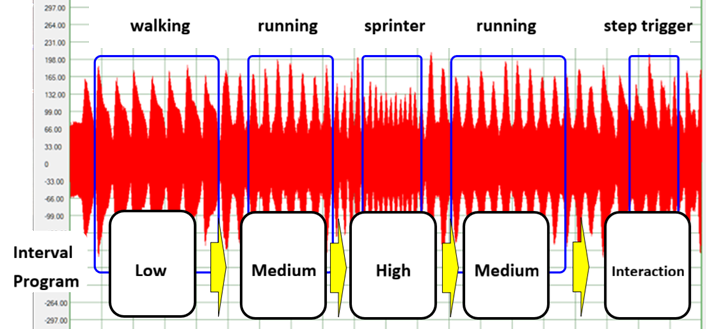
Falls are one of the most critical health risks for seniors, threatening independent living and causing severe complications. Predicting and preventing falls before they occur has been a long-standing challenge. While traditional assessments like gait speed are useful, they have limitations in capturing real-time dynamic instability. The key to solving this lies in a clinical biomarker: ‘stride-to-stride gait variability.’
The Science of Gait Variability
To the naked eye, a senior’s walk may seem stable. However, microscopic biomechanical fluctuations exist between every step. Gait variability measures the consistency of these step-to-step changes. As neuromotor control or balance declines, stride time and step length fluctuations increase. A prospective clinical study demonstrated that stride time variability predicts future falls, whereas simple gait speed could not distinguish between fallers and non-fallers [1]. Analyzing gait variability allows the early detection of balance degradation before actual falls occur.
[1] J. M. Hausdorff, D. A. Rios, H. K. Edelberg, “Gait variability and fall risk in community-living older adults: a 1-year prospective study”, Archives of Physical Medicine and Rehabilitation, 1050–1056, 2001 (PMID 11494184) (Direct Quote: “Stride-to-stride variability of gait was significantly greater in those who fell than in those who did not fall… simple gait speed was not different.”)
Bridging Clinical Research and Real-World Evidence (RWE)
Large population-based studies show that increased variability in step length and double-support time is significantly associated with multiple fall risks [2]. Additionally, local dynamic stability of gait is closely coupled with an individual’s fall history [3]. Capturing this data in daily life rather than artificial labs provides invaluable Real-World Evidence (RWE) for preventive medicine.
[2] Michele L. Callisaya, Leigh Blizzard, Michael D. Schmidt, Kara L. Martin, Jennifer L. McGinley, Lauren M. Sanders, Velandai K. Srikanth, “Gait, gait variability and the risk of multiple incident falls in older people: a population-based study”, Age and Ageing, 481–487, 2011 (PMID 21628390) (Direct Quote: “Increased step length and double support time variability were significantly associated with the risk of multiple falls.”)
[3] M. J. Toebes, M. J. Hoozemans, R. Furrer, J. Dekker, J. H. van Dieën, “Local dynamic stability and variability of gait are associated with fall history in elderly subjects”, Gait & Posture, 527–531, 2012 (PMID 22748312) (Direct Quote: “Measures of stride-to-stride variability and local dynamic stability were significantly associated with the history of falls.”)
These findings demonstrate the potential of gait variability as a digital biomarker. CiKLux (https://www.ciklux.com), a specialized CRO in clinical trial design and project management, is developing the core technology for Elegaiter (https://www.elegaiter.com), a non-invasive gait monitoring platform, to apply these concepts to daily exercise environments.
Elegaiter analyzes treadmill motor current waveforms to collect high-frequency gait dynamics in real time and calculates gait stability wellness indexes. This allows senior living communities and homes to objectively monitor mobility changes and take proactive actions like strength training or environment modifications before falls occur.
Three Practical Ways to Improve Gait Stability
To maintain safe mobility, proactive management such as high-dose strength/balance programs and multidimensional gait screening is essential [4].
– Perform regular lower-limb strength training (squats, calf raises) to preserve muscle mass.
– Incorporate dual-task exercises (talking or counting while walking) to improve cognitive-motor links and balance [5].
– Monitor gait variability indicators during daily walking to detect early signs of instability.
Data-driven scientific wellness is the most reliable guarantee for safe aging.
[4] Cathie Sherrington, Zoe A Michaleff, Nicola Fairhall, Catherine Paul, Anne Tiedemann, Jennifer Whitney, Robert G Cumming, Robert D Herbert, Jacqueline C T Close, Stephen R Lord, “Exercise to prevent falls in older adults: an updated systematic review and meta-analysis”, British Journal of Sports Medicine, 1750–1758, 2017 (PMID 27707740) (Direct Quote: “Exercise can prevent falls in older adults… Programs that include balance training and are of higher dose are particularly effective.”)
[5] Dorfman M, Herman T, Brozgol M, Shema S, Weiss A, Hausdorff JM, et al., “Dual-task training on a treadmill to improve gait and cognitive function in elderly idiopathic fallers”, Journal of Neurologic Physical Therapy, 246–253, 2014 (PMID 25198869) (Direct Quote: “Dual-task training on a treadmill led to significant improvements in balance, gait speed during dual-tasking, and cognitive function.”)
답글 남기기