The idea behind an exergame is always appealing: the player actually moves, and that movement means something inside the game. The hard part was never the idea — it’s deciding what will read the movement.
Where the usual approaches stall
When a team tries to turn a player’s gait into game input, they usually stop at one of two options.
- Camera-based motion capture — sensitive to space and lighting, and the player has to stay inside the frame. Privacy concerns follow.
- Wearable sensors — accurate, but the player has to put them on every time. Forget them, or let the battery die, and there’s no session that day.
Both share the same problem: you have to solve hardware before you can build a game. Resources meant for content drain into sensor tuning.
A different angle: what the treadmill already knows
Elegaiter takes its signal from the equipment rather than the player.
Each time a foot lands on the belt it creates resistance, and the motor momentarily draws more power to overcome it. Every step leaves a trace in the power consumption waveform. The JAWS adapter measures that current pattern in real time, and the analysis engine converts it into gait data.
From a development standpoint, that yields three things.
- The player wears nothing — onboarding friction disappears.
- No camera, no lighting requirements — you’re free of installation variables.
- Any treadmill that runs on electricity works — no lock-in to a specific manufacturer’s hardware.
What the SDK gives you
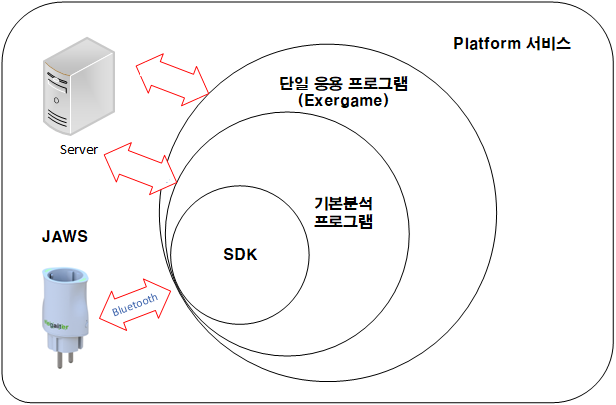
Elegaiter provides native SDKs for Android (Kotlin) and iOS. Once integrated, your app can work with gait information in real time:
- Gait type — walking versus running
- Left-right balance — relative weighting between feet
- Cadence — steps per minute
- Gait stability — step-to-step variation (Median / IQR based)
These values arrive in a form you can feed directly into game logic as input signals.
Integration flow
- Device connection — the SDK pairs with the JAWS adapter over Bluetooth 5.2.
- Real-time data — once the player starts walking, gait data streams into the app.
- Game logic — map the incoming values to character movement, speed, event triggers, or whatever your design calls for.
The SDK ships with a working sample app that implements this flow end to end. Instead of building from documentation alone, you can run real code and lift the parts you need into your own project.
What you could build
Treating gait as game input, a few mappings suggest themselves naturally.
- Speed as progression — tie the walk/run transition to character velocity or the tension of a chase sequence.
- Balance as steering — map shifts in left-right weighting to lane changes or dodge actions.
- Cadence as rhythm — use step rhythm as the beat in a music game or as a combo-sustaining condition.
- Stability as accuracy — reflect step consistency in scoring or precision judgments.
A service interface for linking treadmill gait data to metaverse content — physical games and virtual tours — was already proposed and presented in a paper at HCIK 2023.
Getting started
Elegaiter’s core business strategy is to supply its underlying technology to partners who know their domain best, rather than building every end service itself. In games and content, we believe the experience a specialized studio creates will be better than anything we would build.
If you’d like a technical review or a joint PoC, you can find the partnership paths below.
Elegaiter Partners — Connect to your service →
※ This product is not a medical device and is not intended to diagnose, treat, cure, or prevent any disease.